Dressing the part

Watching television is not a pastime in my house. It’s not that I don’t want to watch T.V., I do. But, my other pastimes–two kids, cooking, and eating–leave little prime time.

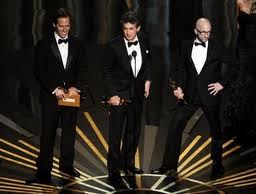
So, imagine my good fortune when Sunday night I watched the Oscars and saw this:

Perfect timing. And followed by this:

Jim Rash, the guy on the far right and writer of The Descendants, imitating Angelina Jolie. Probably one of the TV moments of the year.

Why is it that when I do tune in there is often a wardrobe malfunction?

Posted in Personal Essays | 2 Comments

Mad River Glen delivers

A couple of weeks ago I posted this photo on Facebook with a plea:

Mad River Glen: Please Snow if You Can. The plea worked. This weekend the Snow Gods dumped over two feet of the fluffiest snow I can remember.

Here’s what it looked like on Saturday.

Blue sky and cotton in the trees. I snowshoed up the mountain alone.

At one point, I stopped and listened. I heard the wind, the creak of the trees, the crunch of the snow under my feet, and my heart pounding from the uphill climb. That’s it.

Thank you Mad River Glen for delivering.

Posted in Personal Essays | 1 Comment

Dr. Small’s Diet for Your Brain

Dr. Gary Small at Cambridge Forum lecture

Alzheimer’s, funny?

At many points Thursday night at the Cambridge Forum lecture, Dr. Gary Small a neuroscientist from UCLA and author of a new book, The Alzheimer’s Prevention Program had the audience laughing.

According to Small, this degenerative disease afflicts 36 million people worldwide, robs them of their memory and their dignity, and contributes to many of their primary caregivers suffering from clinical depression. One woman, who wished to remain anonymous, was visibly panicked about her own memory loss and came to the lecture to learn more. Manli Nouri, a biology student, was there because her grandfather died of Alzheimer’s and she was worried her 56-year-old mother might get it. Yet in the unadorned meetinghouse room in the First Parish Church in Cambridge, MA, people smiled.

Dr. Small offered tips for “remembering to remember.” One involved seven unrelated words: Beach, Professor, Horse, Teddy Bear, Cigar, Nun, and Pasta. He asked the audience to imagine these words together in a story, or mental image. People couldn’t help chuckling as they imagined a cigar-smoking nun with a teddy bear-holding professor eating pasta together on a beach. But it worked. People remembered the words.

Maybe it was nervous laughter. After all “every 70 seconds someone is diagnosed with Alzheimer’s,” said Small. And there is no cure.

Nor, it turns out, is there substantiated proof that prevention even works. According to an April 2010 National Institutes of Health (NIH) study, Preventing Alzheimer’s Disease and Cognitive Decline, “Firm conclusions cannot be drawn about the association of any modifiable risk factor with cognitive decline or Alzheimer’s disease.” In other words, more studies need to be done before definitively stating prevention works. “But,” as Small told the audience, “I’m not going to wait 20 years to start protecting my brain.”

His own research as director of UCLA’s Longevity Center, as well as many other studies he mentioned and can be found in his book, contributed to his assertion that making four simple changes to your life might prevent Alzheimer’s or at least prolong its onset. There is no guarantee, however.

Here’s a simplified version of Dr. Small’s daily “diet for the brain”:

1. Physical exercise.  A cardiovascular workout increases blood flow and endorphin release in your brain, which improves cognitive functioning.  “You don’t have to be a triathlete to protect your brain,” said Small. A daily brisk walk will do the trick.

2. Mental exercise. Small recommended crossword puzzles or some of the exercises in his book to strengthen neural circuits. Anything that stretches your brain, including speaking different languages or even juggling, should work. Just like with your physical exercise, make sure you cross train.

3. Stress management. Stress is not good for the brain.  When stressed, the brain receives increased levels of cortisol, which according to studies impairs memory. That means get on your yoga mat or do some deep breathing.

4. Eat well. Small suggested caloric control and a diet high in omega 3 fats and antioxidant fruits and vegetables. Pomegranates here we come.

The best recommendation of the evening?

“Dancing,” Small said, “It’s healthy for its physicality and the cognition needed to learn the moves.” When asked if in partner dancing that meant the leader protected his or her brain more then the follower he said, “Maybe we should do a study on that.”

Everyone laughed.

Posted in Health | Leave a comment

Garbage Burger

The countdown to Anna B.’s birthday has begun. She’s turning 12 on Tuesday. Per the tradition in our house, she’ll chose the dinner. There are usually her two regulars –Lydia’s chocolate cake and raspberries with powdered sugar–but the rest of the menu varies from year to year. This year’s new entry is a Garbage Burger.

Now for a little history. Last spring, Tim grilled some flank steak. The leftover was stored in a sealed plastic bag in the refrigerator. After sitting there uneaten for maybe five days, I decided it was time to throw it out. Into the garbage it went. The flank steak sat in its plastic bag in the garbage for about 10 to 20 minutes.

Dinner time arrived. Our refrigerator and cupboards were pretty bare–bad timing for a cleaning spree. We scrounged around. Then Tim, the master of the BOBS (Best of a Bad Situation) meal said, “I’ll make burgers,” and fished the flank steak out of the garbage, ground it up, and fried it in a pan. Anna B., unaware of its provenance, proclaimed it the best burger ever. I wouldn’t touch it.

We finally did confess to our mini version of a dumpster dive. Clearly, it didn’t dissuade her. She wants it for her birthday.

Here’s the recipe: Marinate the flank steak in soy sauce, red wine, salt, pepper, garlic, with a dash of Aleppo Pepper for a kick. Grill it to medium rare. Serve it for dinner leaving some for leftovers. Put leftovers in Ziploc baggie and store in refrigerator. Remove three to five days later and toss in the garbage. There’s some debate in our family about length of time for this step. Anna B. suggested 24 hours. I think 30 seconds to one minute is plenty.  Grind up meat with a little mayonnaise for moisture and fry it up in a pan.

Enjoy!

Posted in BOBS, Food, Personal Essays | 4 Comments

A Life-Changing Moment

Martha Bebinger is a reporter for WBUR, a professor of journalism at Harvard’s Extension School, a former Harvard Nieman Fellow, and a mother of three. But beneath her accomplished and composed demeanor resides a tragedy. Her father killed himself when she was 17.

“He shot himself with a pistol. He was in a hotel room—a mile-and-a-half from our house in San Antonio, Texas,” she said on a winter evening in a hallway outside her classroom in Cambridge, MA. It wasn’t the first time. He’d tried it twice before unsuccessfully. His diagnosis was schizophrenia although there were no hallucinations–just an inability to control his moods and unpredictable behavior. “I never knew who I was going to encounter,” Bebinger, 51, said of her father who was a civil servant at the Kelly Air Force Base. He tried medication, therapy, and was in and out of psychiatric hospitals but nothing seemed to help, she said.

“I don’t fault my father, he didn’t have the life he wanted,” said Bebinger who has close-cropped grey hair and multiple ear piercings, said. She had just arrived home on that day 34 years ago from her church group’s ski trip. She was in the kitchen when her mother got the call from the police. She listened to the phone conversation and watched as her mother wrote the news of her father’s suicide on the kitchen chalkboard. As the oldest of the four children, she then had to tell her younger brother, 11, who was at a friend’s house.

Bebinger, a resident of Brookline, now has children of her own–one biological and two adopted. Whenever she records her father’s suicide on her biological son’s medical history forms it raises a red flag. “There are assumptions made about my son, 13, and he gets extra attention.”

Bebinger said she doesn’t think about her father’s suicide daily. “But it does feel a part of the undercurrent—part of the fabric of how I see the world–it ripples in ways I can’t believe,” she said.

Posted in Profiles | Leave a comment

Santa JG

Jonathan Meath has an uncanny resemblance to Santa Claus. He’s just the right height—not too tall, nor too short. His body type is perfect—no pillows needed. And his real beard and dyed eyebrows are the color of freshly fallen snow.  Even when he’s not in his so-called “business suit” kids wave, “Hi Santa!” Off-season, adults have looked him in the eye and said, “Too early.” Or please, it’s not the Christmas season.

“If I was 12, I would probably be embracing Harry Potter. But, I have a long white beard and I like to sing and Santa likes to sing,” said Meath, 56, a longtime children’s television producer and now Santa Claus for hire.

Meath’s job path veered in this new direction five years ago.  One summer morning in 2006, he soaked in his claw-footed bathtub beneath a window in his duplex in Cambridge, Massachusetts. He pondered the Go For It speech he was about to deliver a friend who was contemplating moving to Los Angeles to become a musician.

“The light dawned on my marble head; I should be doing what I was preaching,” Meath said on a stroll around his neighborhood on a crisp November day, “Santa was presenting himself to me but I hadn’t been listening.”

Meath realized Santa was a way he could perform and sing—two things he loves. So before leaving the tub, he came up with a to-do list and checked it twice. He then went downstairs to tell his now ex-wife of his plans.

She wasn’t surprised. A year before, she had bought him his Santa “business suit” on eBay thinking he would make a good Santa. But, he’d been resistant to the idea, “It didn’t seem viable as a job path,” he said.

Meath decided if he was going to Go For It, he wanted to be one of the best, most authentic Santas–or Premiers as it’s said in the business. To achieve this, his personal to-do list included: 1. Be on the cover of the Lands End catalogue. He’s done that. 2. Sing with the Boston Pops. Check. 3. Make the cover of Boston Magazine. Nailed that first Christmas season.

Being a Premier Santa means the phone never stops ringing. It means working for a fancy brand like Neiman Marcus and performing at the White House or in the movies. It can also mean $40-50,000 a year.

But, there’s competition. To achieve this, Meath is building his brand. He wanted his Santa googlable, so he added a moniker, JG. (Jonathan Greenwood–his first and middle name. Or maybe, as he suggested, Junior Grade to distinguish him from other Santa’s helpers.)

Santa JG tweets. He blogs. His photo can be found on the Wikipedia page for Santa Claus.  He’s been on NPR. He’s produced an album, Santa JG Swings!, and has a second on the way. He even has three booking agents—Los Angeles, New York City, and Boston.

At $200 per hour, he’s performed in malls, hospitals, and even a Red Sox commercial. He traveled to Japan for a multi-week gig last year. Next on the horizon? China. “Like the Polar Express, there are new ways of spinning the Santa tale. There is a ready-made platform for launching Santa in China,” he said.

All of this success is understandable. Santa JG is committed. “It’s taken me five years to grow my hair to where I like it where I think it looks like my version of the old elf. I would like it to be about 2 inches longer because when it curls I want it to fall on my shoulders rather then touch my shoulder,” he said. He’s a board member of the 750-member Fraternal Order of Real Bearded Santas and attends Santa conventions around the country.

Although being Santa is a modeling job first and foremost, Santa JG’s portrayal is not just skin deep. “He takes on the persona of Santa. His spirit is so genuine,” said Amy Haelson, the executive director of Dedham Square Circle who has hired him for their holiday stroll three years in a row.

“My Santa is an Old World Santa. He reminds us that life is not dark and is full of celebration and joy,” Meath said. He believes we need mythical characters in our culture–characters that are all good. He quotes Joseph Campbell and Carl Jung in defending this belief. “Santa is about joy and light and giving and love and caring. He doesn’t carry a gun; he’s not about aggressiveness. And even though he has a material side to him he is not about possessiveness. He’s about gifting,” he said.

But being an authentic Santa isn’t all jolly.  Last Sunday, on the way home from a gig, he realized on Route 128 he had left his so-called Man Bag (Santa JG’s business suit doesn’t have pockets and he needs to keep his keys and credit cards somewhere) on the roof of his red Prius with OldElf on the license plate. He pulled over to pick everything up. His cards were found but his Prius’ Smart Key was run over. He had to be towed.

“I was distracted by romance,” he said about leaving his bag on the roof. He and his microbiologist girlfriend had squabbled. “She says I’m great; she likes everything about me. Except, she told me, I’m not sure I can hang out with a fat man,” he said.

At a tree lighting in Dedham on a recent Friday night, children packed the square and the sing-a-long in a synagogue a few blocks away. Dressed in his Savile Row-quality, plush, velvet suit, including a leather belt stitched with Christmas trees and leaping reindeer, Santa JG rocked out to Jingle Bell Rock and sashayed his hips like a Spanish dancer to Feliz Navidad.

“I’m a high-fiving, fist-pumping, jiving Santa. And unlike other media jobs, being Santa is one you can’t age out of,” Meath said.

Posted in Profiles | Leave a comment

The Facebook Story

There have been a lot of raves for “The Social Network”—David Fincher’s sensational, agile, frightening, yet sometimes comic story of the founding of Facebook and its founder, Mark Zuckerberg. They’re mostly true. I was shocked, appalled, impressed, and always riveted by this unlikely action-packed thriller of algorithms and what seems like Asperger’s on the part of Zuckerberg.

The story: Zuckerberg (Jesse Eisenberg) gets dumped by girlfriend Erica (Rooney Mara); blogs nastiness about her out of rejection; sets up site rating (hot/not hot) female Harvard students; and constructs “The Facebook” for Harvard. This spreads virally to other campuses and becomes Facebook reaching one million users (it’s now at 500 million). Zuckerberg becomes darling of Silicon Valley and billionaire. All the while, Zuckerberg is exploiting friends while building his network of “friends” so big that Erica will notice him again. The last scene is of him trying to “friend” her and refreshing her Facebook page. It’s the perfect Hollywood story. The first thing my husband and I said to each other as we were leaving the theater was, “Asshole. Let’s cancel Facebook.”

Then I got home and read beyond the reviews. It turns out, as I discovered in The New Yorker profile of Zuckerberg, much of the premise of the movie is false. The real Zuckerberg had a steady girlfriend the whole time. Oops. He also didn’t care about getting into one of the exclusive Harvard clubs (another motivation in the movie). I wonder what else isn’t true. This new information reduces the emotional impact but I still recommend it. (After all, it is not a documentary.) It’s a tale of our time, Eisenberg is brilliant, Aaron Sorkin’s screenplay is scintillating, and much of it takes place right here on campus.

Posted in Writing About the Arts | Leave a comment

Pipilotti Rist

I was concerned about the sheep’s breath. He had his face so close to mine that I was worried that he might kiss me. He hoofed it right up close and his furry snout was millimeters from my lips.

No, I wasn’t in the Berkshires. This ovine was at the Luhring Augustine Gallery on W. 24th Street in New York City. He and his wooly friends were starring in “Heroes of Birth” a smile-inducing exhibition by Swiss artist Pipilotti Rist. “Layers Mama Layers”–an installation of scenes of sheep in a verdant and lush meadow projected on cascading diaphanous fabrics hanging from the ceiling—greeted me as I walked in. Peter Schjeldahl in The New Yorker said, “[Rist] is an evangelist for happiness like no other first-rate artist that I can think of…” He’s right. This exhibit was an antidote to the sharp elbows and adrenaline I had just experienced at the Matisse show at MOMA.

Pipilotti is a childhood nickname that emerged from “Pippi Longstocking”– her given name is Elisabeth Charlotte. Although Rist doesn’t have horizontal braids like her namesake, the whimsy and sunniness of her art makes me think she channeled something more than just a nickname. But don’t let the optimism of her name be confused with sentimentalism.

Once I left the pasture I moved into the boudoir. Rist’s other installation, “Massachusetts Chandelier”, is a tiered collection of warmly illuminated, decorous, and colorful underpants also suspended from the ceiling. It reminded me of a genial gathering of old friends and relatives.

It was refreshing to see unangstful art like this. I can’t wait to see what Pipilotti Rist is up to next.


Posted in Writing About the Arts | Leave a comment

The Power of the Stage

The Laramie Project by Moises Kaufman and members of the Tectonic Theater Project is narrative journalism at its best. And the production performed at the Cutler Majestic Theater in Boston, a part of ArtsEmerson’s inaugural program, is a riveting and emotional performance.

The story is this…Five weeks after gay student Matthew Shepard was left to die tied to a fence in Laramie, Wyoming members of the Tectonic Theater Project traveled there from New York City, their home-base. They conducted 200 interviews over the following year with people in Laramie from Reggie Fluty, the policewoman who arrived first at the crime scene; to Catherine Connolly, an openly gay professor at the University of Wyoming; to Matt Mickelson, the owner of the Fireside bar where Shepard was last seen that fateful night in October 1998.

Eight cast members, with the simple donning of a hat or the removal of a jacket to signify a transformation, portray more than sixty characters. The play flows from one monologue to the next creating a deep and textured account of the murder that brought national and international attention to the issue of homosexual hate crime.

The Tectonic Theater Project, with unfussy staging and virtually seamless metamorphosis by the actors, strips away all that might distract the audience from the power of the words. It holds the audience in silence despite the length of the play (two hours and forty-five minutes) and the teeth-chattering temperatures in the theater.

Posted in Writing About the Arts | Leave a comment

Kay Rosen’s Words

Scrabble anyone? Try this one…PNUUMLDE.  Hmm. I stared at those alternating charcoal and slate gray letters on the wall of the Kay Rosen exhibit at the Barbara Krakow gallery in Boston on Friday for a long time. I sounded out the letters. P n u u m b l d e. Pnuumlde. Nothing came to me. What’s a Pnuumlde? Sounds like something from Dr. Seuss. But as I continued to look at it I found my eyes swinging back and forth from the tallest “P” to the tallest “E.” Aha. Pendulum.

Like Andy Warhol with his Campbell soup cans, Kay Rosen takes everyday words, pulls them out of context, and morphs them into something that is both playful and provocative.

Try this one…

T

N              E

In Tea? Entity? In Tent E? Why the triangular shape with a “T” at the peak? I couldn’t figure this one out. I cheated and looked at the title. (The answer: “Tent.”)

According to ARTFORUM magazine, Rosen was trained as a linguist. She started “manipulating words —via juxtaposition, scale, and color—in order to highlight their inherent fluidity and its complex implications.”

Last one…

LI  E

LI  E

Two LIEs? What’s missing? Why the blank spaces? Why one stacked on the other? Again, I am stumped. But when I glance at the title…“Slice of Life”…I feel a chill pass through me.

If art’s job is to make you look at the world differently then Kay Rosen, in this tiny exhibit, has done her job.

Posted in Writing About the Arts | Leave a comment