Indulgence on Route 2: A Christmas Tradition

Image

December is almost here and it’s time to start thinking about Christmas trees. In our neck of the woods, many people I know choose to cut down their own Norway spruce or red pine. They usually drive to New Hampshire or the Berkshires, hike to a pristine place, and breathe in a lot of fresh air. Sounds so romantic. But in our family, we opt for the already cut variety at Gerard’s, a farm stand/boutique, on the busy Route 2 in Lincoln, MA. Believe me, it’s not because we don’t love nature or because we love car exhaust. It’s not even because it’s close.

It’s because there’s something magical about Gerard’s and a visit to his shop at Christmas time has become a family tradition. Every December, my husband and I and our two kids, ages 12 and 10, pile into our station wagon and drive 20 minutes west. We zoom past Gerard’s on the left and make a u-turn about a mile up the road. We pull into the parking lot, giddy with anticipation.

My husband, Tim, scouts for a Frazier fir while Sammy, Anna B., and I race past the cedar garlands and refrigerator filled with mouth-watering homemade fruit pies into the little store. Inside we find the impractical and often pricey Christmas decorations that we have come to treasure. After all, isn’t that what Christmas is all about? A little indulgence? There are red currant scented candles, sparkly rain deer wearing faux-mink collars, oversized antique etched glass ornaments. Gerard, originally from Belgium, and his wife, Amy, have had the shop for 18 years. Antique and new finery, much of it from Europe, fills their shelves inside. Local products including decorated wreaths and apple cider can be found outside. We come for both.

Sammy and Anna B get to pick one decoration each—ornament or accessory—every year. (And we all get one of Gerard’s homemade chocolate turtles, conveniently located next to his cash register, to eat on the drive home.) The first time we did this, seven years ago, the conspicuous and brightly-colored mini trees that Anna B and Sammy chose flummoxed me. After all, Tim and I had been celebrating Christmas together for 15 years and we had our aesthetic all figured out—nothing too frou-frou and little white lights on the tree.

Anna B and Sammy’s choices derailed my vision. How could glitz and sparkle fit with our minimalist approach? But I held my tongue and added two new doodads to the Noel decor in our living room. At first I resented their showiness and thought they tarnished the scene. But after a little while, I came to love them and what they represented. Christmas wasn’t just about my aesthetics, after all. It was about building a tradition together as a family. And color and sparkle was part of that package.

So this year look for us at Gerard’s. Who knows what wild ornament we’ll be carting out this time. Whatever it is, I’m sure it will look great with our Christmas tree beautifully lit up with blinking, colorful lights.

Posted in Local, Personal Essays | 1 Comment

Image

Believe it or not, Maine’s main export is not lobsters.[1][2] But Maine is known as “vacationland” and lobsters bring the tourists in. So in the summer of 2003, Gourmet Magazine sent the writer David Foster Wallace to investigate the ground zero of lobsters, the Maine Lobster Festival, MLF, in the heart of the midcoast region. One would imagine the article would be a paean to lobsters and the beauty of the Maine coast. After all, Gourmet (now defunct) was a fantasy magazine for foodies and travelers. But Wallace, a not-so-closeted moralist and master of erudition and rhetoric, took the reader on a different journey. One in which their taste buds had to confront[3] their consciousness.

“Consider the Lobster,” starts out as a breezy tour of the picturesque Penobscot Bay in late July. We learn the taxonomy of a lobster and its evolution from poor man’s slop to rich man’s delicacy. We discover lobster migration patterns, their water temperature preferences, and the difference between those with hard and soft shells. Our mind wanders to a summer meal of lobster dipped in garlic, lemon, butter sauce and the smell of warm homemade blueberry pie. Our collective mouths begin to water.

Then Wallace enters the Main Eating Tent of the festival and his carefree tone begins to shift. Now he’s noticing the “Disneyland-grade queues,” the noise from “crackling, chewing, and dribbling,” and the Port-O-San facilities with no place to wash your hands. Our mouths are watering less and we’re wondering where we might have left those sanitizing wipes.

But then Wallace’s tour lulls us back into our summer reverie with dreams of cracking open a lobster claw and savoring its succulence. But he spies the World’s Largest Lobster Cooker and poses the question, “Is it all right to boil a sentient creature alive just for our gustatory pleasure?” After all, a not so publicized fact Wallace points out is that lobsters, unlike other animals, are cooked alive.[4] Now the story turns to the cooking methods of these crustaceans.

With details of the lobster’s “stresses of captivity” and its “rabbit-like-death-scream” when plunged alive into boiling water, Wallace collides[5] headfirst into his PETA[6] alter ego. And we, the reader, are plunged into the murky ethical considerations of eating lobsters. Now, we’ve lost our appetite and vow to consider the vegetarian option the next time we’re at a restaurant.

This is vintage Wallace. He’s a moralist, a fire-breathing preacher of consciousness. “Wake up people!” you can hear him screaming from his pulpit. “Be conscious about your decisions! Don’t just eat those lobsters! Think about them! Think about your actions! Consider the Lobster!!”

Wallace worries about his tone and that he might “come off as shrill or preachy when what I really am is more like confused.” After all, he’s a meat eater and wants to continue with his carnivorous diet. But he wants to make sure that he and the readers of Gourmet, “The Magazine of Good Living” as he says, are mindful of their choices and not reacting in a “hard-wired way.

Consciousness-raising is Wallace’s hard-wired way. As he said in a New Yorker profile, “This is a generation that has an inheritance of absolutely nothing as far as meaningful moral values, and it’s our job to make them up.” But as he noted in his “This is Water” commencement speech at Kenyon College in 2005, “It is unimaginably hard to do this, to stay conscious and alive, day in and day out.” But try he does. In “Consider the Lobster,” he prods us to think about what’s at the end of our fork.

Wallace who died at age 46 in 2008[7 is believed to be one of the greatest writers of his generation. He won a MacArthur “genius” fellowship and other awards and has been described by critics as both “a contemporary American master” [8] and a “snowboarder with a PhD”[9] His writing is precise and intellectual yet humorous. He strikes a balance between the personal and the reportage. He’s also the re-inventor, or re-invigorator, of the footnote. Those typically dull representations of academic writing come alive in Wallace’s capable hands.

In “Consider the Lobster,” it is in his footnotes that his tone finds its bully pulpit. These footnotes, more like riffs, are where Wallace questions, opines, and meanders. They are essential to the story. These morsels often contain his main point and in this essay sometimes fill up half a page. They are trademark Wallace and he described them to interviewer Charlie Rose as “reflect[ing] his perception of reality without jumbling the entire structure.”

This structure allows him to report on the topic, lobsters, in a detached, journalistic manner. But in the footnotes, he connects to the reader through his personal reactions. “They come up alive in the traps, are placed in containers of seawater…” he writes benignly in the body of the text. In the corresponding footnote, he goes into gruesome detail about the inhumane practices in a “standard meat-industry operation” including the debeaking of chickens without anesthetic, the dehorning of cattle, and the clipping of swine’s tails.

These footnotes are also why some critics, including this one, find Wallace both exhilarating and maddening.[10] On the one hand, his intelligence, wit, and penetration of subjects in this article as well as others in his book, Consider the Lobster and Other Essays, is breathtaking. On the other hand, to read one of his essays requires not only a good deal of patience because of these sentence interrupters but a pair of extra-strength magnifying glasses to read them.[11]

Readers respond passionately to David Foster Wallace so it’s no surprise that the amount of letters Gourmet magazine received in response to the original article were record-breaking. In the September 2004 issue, in a section called “sugar and spice,” a reader named Dana N. Wilson wrote, “The article was brilliant, probing, daring, and brutally honest.” The next letter from Shelly Keller asked, “What were you thinking when you published the lobster story? Do you think I read your magazine so you can make me feel uncomfortable about the food I eat? I will never eat or cook another lobster.”

One can imagine Wallace was pleased with this passion. After all, “Consider the Lobster” was meant to provoke. Early in the piece, Wallace describes lobsters as “garbagemen of the sea, eaters of dead stuff.” Three pages later, he writes, “As a tourist, you become economically significant but existentially loathsome, an insect on a dead thing.” It seems that Wallace not only considered the lobster, he also considered the human.


[1] It’s electronic integrated circuits according to the United States Census. But that’s truly unromantic. Can you imagine a lollipop in the shape of a circuit? And I don’t think cuddly, stuffed circuits would sell well. So, despite lobsters ranking of 4th on the Census list, the Maine Tourist Board has elevated their status.

[2] Oh, and a footnote to that footnote: I’m using footnotes in the David Foster Wallace, DFW, style because emulation is an expression of reverence.

[3] More like collided with.

[4] He wonders if we would ever kill a cow in public like that or debeak a chicken?

[5] Perhaps he slipped on some butter and skidded into a lobster tank?

[6] People for the Ethical Treatment of Animals

[7] Wallace hanged himself in 2008 after decades of battling depression.

[8] Robert McCrum in the Guardian said this and I’d have to agree. Although, honestly, I haven’t read all the books written by 40-somethings.

[9] That was Peter Grier of The Christian Science Monitor. I think it’s a weird metaphor but it just shows how frothy reviewers can get after reading Wallace.

[10] This ambivalence seems permissible considering Wallace employed it in “Authority and American Usage”. “In this reviewer’s opinion, the only really coherent position on the abortion issue is one that is both Pro-Life and Pro-Choice.” If he can have it both ways so can said reader in analyzing “Consider the Lobster”.

[11] Said reader experienced asthenopia, or eye strain, from reading the piece and this is despite adequate lighting and attractive reading glasses from a pharmacy in Venice, Italy. Oh, but that’s another story altogether.

Posted on by sarahbakerstories | 2 Comments

Introducing BOBS

Today I am adding a new tag to this blog. I’m calling it BOBS. I know that BOBS is not the most pleasant sounding word. In fact, it could easily be confused with BLOBS—a particularly unpleasant word. But once you know about BOBS, you’ll start to see it everywhere.  You’ll find it in the kitchen. You’ll remember it when traveling. You might even summon it on a bad hair day. Before you know it, you’ll be creating your own BOBS and spreading the word.

BOBS © stands for Best Of a Bad Situation. It’s an ugly word for a beautiful idea.

Stay tuned.

Posted in BOBS | Leave a comment

Why I love where I live

Diana Vreeland, according to the new documentary about her, loved to turn people’s defects into their assets–like a celebration of Barbra Streisand’s nose or  Lauren Hutton’s gapped teeth to name two. That concept inspired me to flaunt something I’ve always tried to hide. Yikes. Can I say Opening A Can of Worms? But I’ll just start at the bottom…with my feet.

I live in Cambridge, Massachusetts. I came here against my will. I didn’t want to move from New York City. I thought I would die leaving New York City. “People wear ugly shoes in Cambridge,” I said to anyone who would listen. But my husband got a job here so we moved. I was mad at him for a long time. Okay, five years to be exact. But I’m over that. Now, I love Cambridge, Massachusetts. I think it’s the greatest place on earth to live. And chief among the reasons is the shoes.

Before I moved to Cambridge, I thought those giant protrusions on the side of my big toes were bunions. That is until I saw a doctor. I begged him to just shave them off. “If only it was that simple,” he said. Turns out, “your feet are deformed,” he told me. My big toes got the wrong directions when growing. Instead of Stay Straight the one on the right heard Head East and the one on the left heard Head West. Now each hallux (that’s the word for big toe) nestles snuggly into its neighbor. All of that might sound kind of cozy if shoes weren’t mandatory. They are. Even in beautiful Cambridge bottles break and dogs poop and who wants to step in either?

Not me. But fixing my feet is no walk in the park. In fact, I wouldn’t be able to do that for weeks or months.  In New York City, I felt obligated to wear stylish shoes. Or to be perfectly frank, I’m vain so I wanted to wear stylish shoes. Which meant my feet hurt all the time. I found temporary relief at Sacco Shoes on the Upper West Side. They made beautiful shoes for women who walk. Imagine! But then they went out of business. So it’s a good thing I moved to Cambridge. Here my feet are very happy in my grey Birkenstocks. And so am I.

Posted in BOBS, Personal Essays | 2 Comments

Jealousy

I was just thinking how powerful art can be and thought of a review I wrote of Julian Opie’s show at the Barbara Krakow Gallery in Boston in 2010 for Art New England. That review at 360 words couldn’t possibly tell the whole story so here tis….

Her name was Suzanne. She had a swimsuit model physique. (And, perfect lines.) I couldn’t see her face but she held forth in my living room and pulled all eyes and energy toward her, like a black hole. I felt jealous and insecure in her presence, fearing my husband might fall in love with her. She had to go.

So, we packed her in Styrofoam, a cardboard box, and strong tape to keep her safe. “Watching Suzanne (front)”– a black and white computer-generated enamel on glass portrait of a bikini-clad torso–by now fifty-one year-old British artist Julian Opie was returned to the Boston gallery that had loaned her to us. No, thank you.

This happened a few years ago when Opie was less well known in the United States. Now, “his work is incredibly popular,” according to Andrew Witkin (a friend) at the Barbara Krakow Gallery “because it is somehow familiar yet has the wow as well.” This combination has meant success. His shows sell out.

Opie’s latest exhibit, a collection of twenty-eight portraits, (at Barbara Krakow Gallery through December 7, 2010) represents the breadth of his work. Half of them, the most provocative and my favorites, are like “Watching Suzanne”—simple yet bold. His trademark of black lines with minimal detail against monochrome backgrounds is apparent in all these works. You can also understand why some have referred to him as “the master of the stick figure”. Opie, himself, compares these images to a “logo for a person”. “Verity Walking”–a young chicly-dressed woman set against a brown background striding along as if to her Madison Avenue office–is an example in this show. For the most part, the women are highly stylized and often nude and the men range from frumpy in “Enis Walking” to lithe in “Ryoichi and Mara”.

Opie is an original. But, he’s not an inventor. He’s a re-mixer. He compares, he references, and then he simplifies. If he were a writer, according to an interview with him in Graphics International Magazine, he’d be Raymond Chandler. “[Chandler] doesn’t sit there and write about the way he feels, or what his observations on the world are. He writes a detective story.” Plain and simple. And, in two words, that’s what Opie’s traditional works are. He reduces objects to their most essential lines. Their most fundamental forms. Fourteen of the portraits in this show, for example, are without eyes (or noses or mouths, for that matter). Instead, the heads are thick black-lined circles with skin tones that seem to come straight out of the Crayola multicultural crayon box. And they float above their shoulders with no neck to hold them.

The other fourteen, his newer styled portraits, have eyes, necks, and a parlor or a landscape as a backdrop. They are more modeled and specific but like Opie’s classics, equally generic. It’s ironic that the more detail he includes, the less dynamic and inviting the portrait. Maybe it’s because none of the people are smiling. “Alyssa with Pearls” has disdainful eyes and the darkly lit “Marina in Purple Shawl” looks as if she might just cut you out of her will.

Opie has been drawing since he was eleven years old. But now his computer is his “sophisticated drawing tool”. He starts by taking digital photos or movies and imports them into his vector-based drawing software, like Adobe Illustrator (a system used by graphic designers) that allows him to draw with curves. He then works with different printers, sometimes even an awning or sign manufacturer, to produce his images. Some of his works are shown on computer/LED screens. Others, in addition to this exhibit and museums like the ICA in Boston and the Tate in London, can be found on CD covers, billboards, building facades, and book jackets. “Art is a processing of reality,” Opie said in an interview with The China Post.  And his own method of production—from person to computer manipulation to output–seems that he is quite literal in that interpretation.

Opie studied at Goldsmiths College in London with the British conceptual artist, Michael Craig Martin, who influenced him and is considered a key figure in the Young British Artists (YBA) movement—of which Opie is a member. Martin’s other pupils included Damien Hirst, Fiona Rae, and Ian Davenport.

It might seem paradoxical that Opie, a post-modern pop artist, finds his inspiration from 17th and 18th century Dutch portraiture and the 19th century woodblock prints of Utagawa Hiroshige, a Japanese ukiyo-e artist. The Dutch influence is apparent in the acrylic “Felicia with Peony against Landscape”–a woman in a blue evening gown posed in front of a red velvet curtain gazing anxiously into the distance. The composition could be straight out of a Ferdinand Bol portrait. But in this piece, Opie mixes 17th century composition with 21st century angst.

The intimate “Joo Yeon Contemplates her Imminent Wedding”–a continuous computer animation of an delicate young woman with blinking eyes, oscillating earrings, and swaying cherry blossoms in the background–with its striking colors and seasonal allusions suggests Hiroshige.

Opie’s art, although simple in form, is a mish-mash of styles. It’s part manga (or Japanese animation) with its minimal lines and dots for eyes in some of his earlier works. It’s part Warhol-influenced Pop Art in that his portraits, in their generic quality, suggest the homogenization of the modern soul. His method of creating two-dimensional, computer-generated images has made graphic designers think of him as an artist and artists think of him as a graphic designer. Yet, his portraits have classic compositions.

What’s consistent in all of them is movement. Opie’s choreography is obvious in his continuous computer animations. But even his still pictures suggest action. In both his “Caterina Nude” and “Ed and Marlanela” series, he captures the grace of his dancers. In earlier shows, his models are straight out of a strip club (dancing around a pole) or strutting like a catwalker. As he said, “Humans are always moving. Even sitting down, they are quite animated. So, to depict humans in a realistic way [I] need to use movement.”

Opie has long been examining how we as viewers see things. When he removes the details, leaving his bold lines and colors, his work is arresting. Those lines are powerful. I know because “Suzanne” spent a night in my house.

Posted in Writing About the Arts | Leave a comment

Home

A few years ago a friend asked me to write an essay about Home. This is what emerged. 

The view from our apartment painted by our neighbor Betsy Goldberg

Mom died when I was eight. Seven months later, Dad, my brother Sam, and I packed up and pulled out of our beloved Georgian brick house outside Washington, D.C. We left behind our cul-de-sac of dodge ball and barbecues, hide and go seek in our magnolia tree, and my favorite rose in the garden, “Yankee Doodle Dandy,” which was the color of orange sherbet. A neighbor removed Mom’s elegant silk scarves, the ones she tied gracefully off to the side to cover her bald head, the silver bell she rang when she wanted company, and her closet full of clothes from Lord & Taylor, donating them to our church. We left Mom, alone, buried on a hill in Arlington National Cemetery.

Dad’s next deployment in the Navy required he attend Captain school at the Naval War College in Newport, Rhode Island. “Laurelawn”, a flat in a mansion on Bellevue Avenue, was home for the summer.

Then, in August, we shoved our belongings into suitcases and flew to Fullerton, California. Dad’s older sister and her five children looked out for us during the week. Dad had us on the weekends, when he wasn’t out to sea.  Every Friday night, we rode the train to San Diego; every Monday morning he drove us back. This lasted for three years. At the end of this time, four of us relocated back to the Georgian outside of Washington, D.C. The fourth was Debbie, whom Dad met along the way.

Dad married Debbie. A year later, we came home from school to a note, “marriage isn’t my thing” and a house empty of her belongings.

A year after that Dad married Stephanie, an old flame. This time the Navy shipped us to a stucco bungalow in Aiea, Hawaii. Sam stayed behind to finish school. I went to the local school, where I was an outsider because of my light skin and blonde hair. After a year there, I moved in with Dad’s younger sister and her three boys in Pacific Palisades, California. I went to a Catholic school, but Hollywood reigned. My friends were daughters of celebrities. One classmate, Eden, got a red, convertible Mercedes for her 16th birthday. Cocaine was a favor at parties but I worked scooping ice cream at Haagen-dazs. Two years there and I was off to college.

Four years in college, including one in Paris, and I stuffed my VW Rabbit full and drove to San Francisco. I rented the basement of a house in Cow Hollow. One year there and my landlord asked me to leave–too many guests and too much steamed broccoli—both irritants to their life upstairs. This time I traveled across the Golden Gate Bridge to Mill Valley, and bunked with friends. But I spent most nights at my boyfriend’s apartment in the city.

The boyfriend, Tim, got kicked out of his apartment because of The Illegal Tenant. Together, we gathered our possessions and encamped in a redwood grove at the top of Mount Tamalpais. What we fondly called a moldy shoebox—a studio with wall-to-wall carpeting–became our home. Six months later, we crammed a U Haul and ventured to student housing near Columbia University, where Tim was attending graduate school. We got married, and a year later moved into a maid’s apartment at the top of a brownstone on W 76th street. If we scaled the fire ladder outside our window we could reach the roof and see Central Park. We itched to own and found a possibility on the 12th floor facing south and west on the corner of West End Avenue and 103rd Street.

Two weeks later, when I was visiting my brother in Poland, Tim called. “I spoke to the real estate agent this morning,’ he said. “It’s ours.” I put down the phone and didn’t sleep for a week. Every night I tossed and turned, terrified of the cost and the commitment to one place.

When I returned from my trip, the first thing we did was load up on protective eye gear and dust masks. We demolished cupboards, light fixtures, and meat hooks that were hanging from the kitchen ceiling. Everything was carted outside to a big dumpster. A crew from Home Depot rebuilt the kitchen; Tomo, with his improbable crew of 20, chatting in Cantonese, painted the walls; Mike, an English major from Columbia University, translated our sketchy designs into elegant bookshelves; and Sean, with his lilting Irish accent, finished the floors. Eight months later, we hauled in all that we had accumulated and stored at various relatives’ houses–furniture, lamps, boxes of books, photographs, bikes, skis, artwork, unopened wedding presents and clothes. We unpacked and moved in.

Every day after that, like clockwork, at 6:00 p.m. in my Soho office, I began to suffocate. My head ached, my mouth parched, my mascara, like a football player’s eye black, collected under my eyes. I crammed my things into my bag and ran out the door to the subway. The noise, smells, and delays on the train were insufferable. I arrived at my stop, hustled my way up the block to our building, threw a quick, “How was your day?” to Ronnie the doorman and punched the elevator button. On the 12th floor, I scrambled for the door, kicked off my shoes, and dove for the daybed.

Under our window, trucks passed, cars honked, babies cried, dogs barked, motorcycles reved, highways merged. Yet I sat still. Staring out at the Hudson River, I watched the brightly painted tugs towing the tankers. I unclenched. As the sun began to set over the polluted New Jersey skies, I breathed deeply. I walked to the stereo and turned on music, I danced. No one was watching. I was peaceful. I was home. I was settled. No more packing, no more being shipped, no more displacement. Twenty-three years after Mom died, I stopped moving. Finally.

Posted in Personal Essays | 6 Comments

Jefferson’s Veggie Garden

In April, my family and I visited Monticello. Our purpose wasn’t really to see the house, an icon of early classic revival style, but to spend time in the vegetable garden. My uncle, Peter Hatch, the director of gardens and grounds and reviver of Jefferson’s esteemed garden, is retiring in June after 35 years. I wanted my family to explore it with him before his departure.

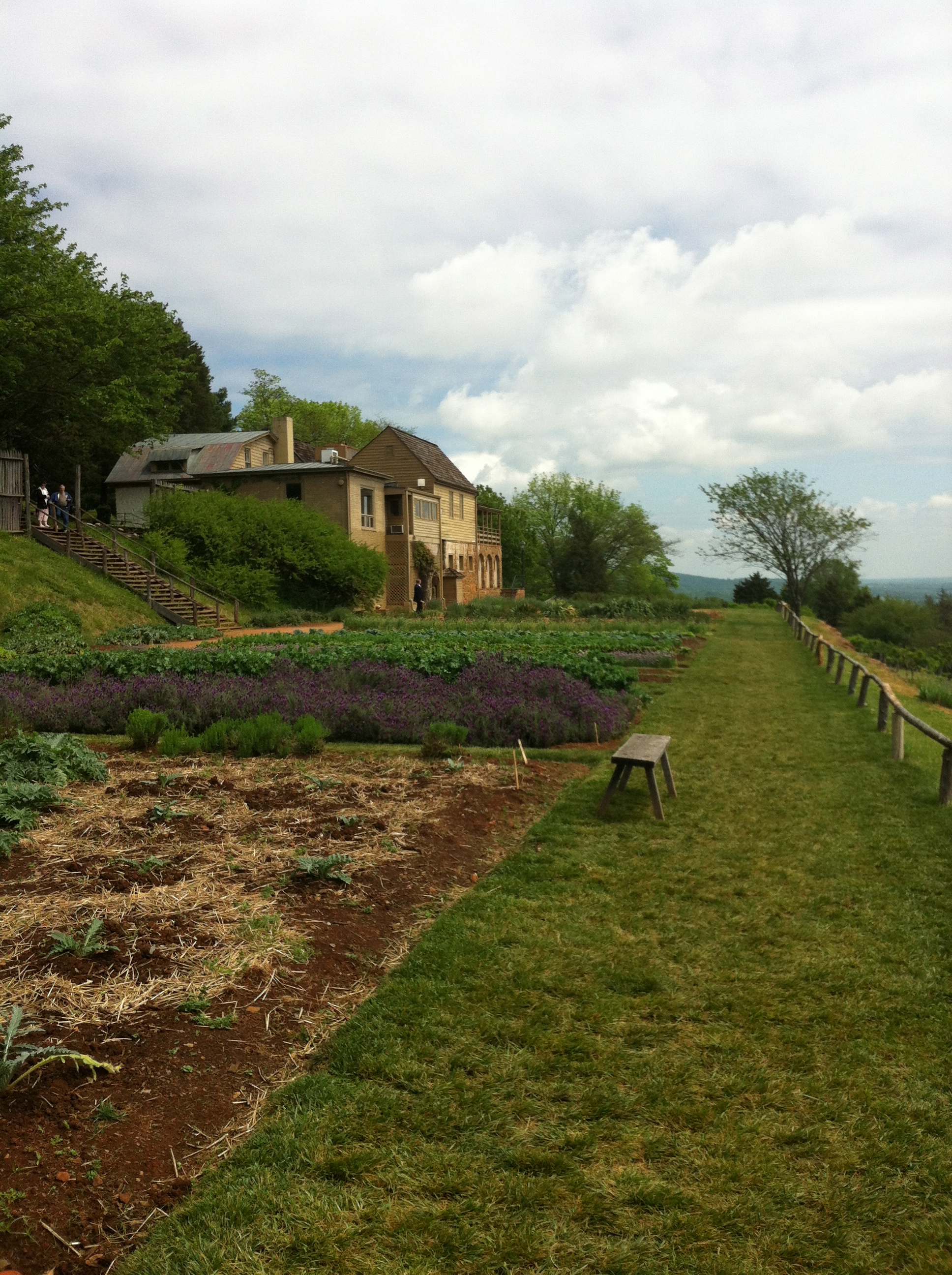
The garden

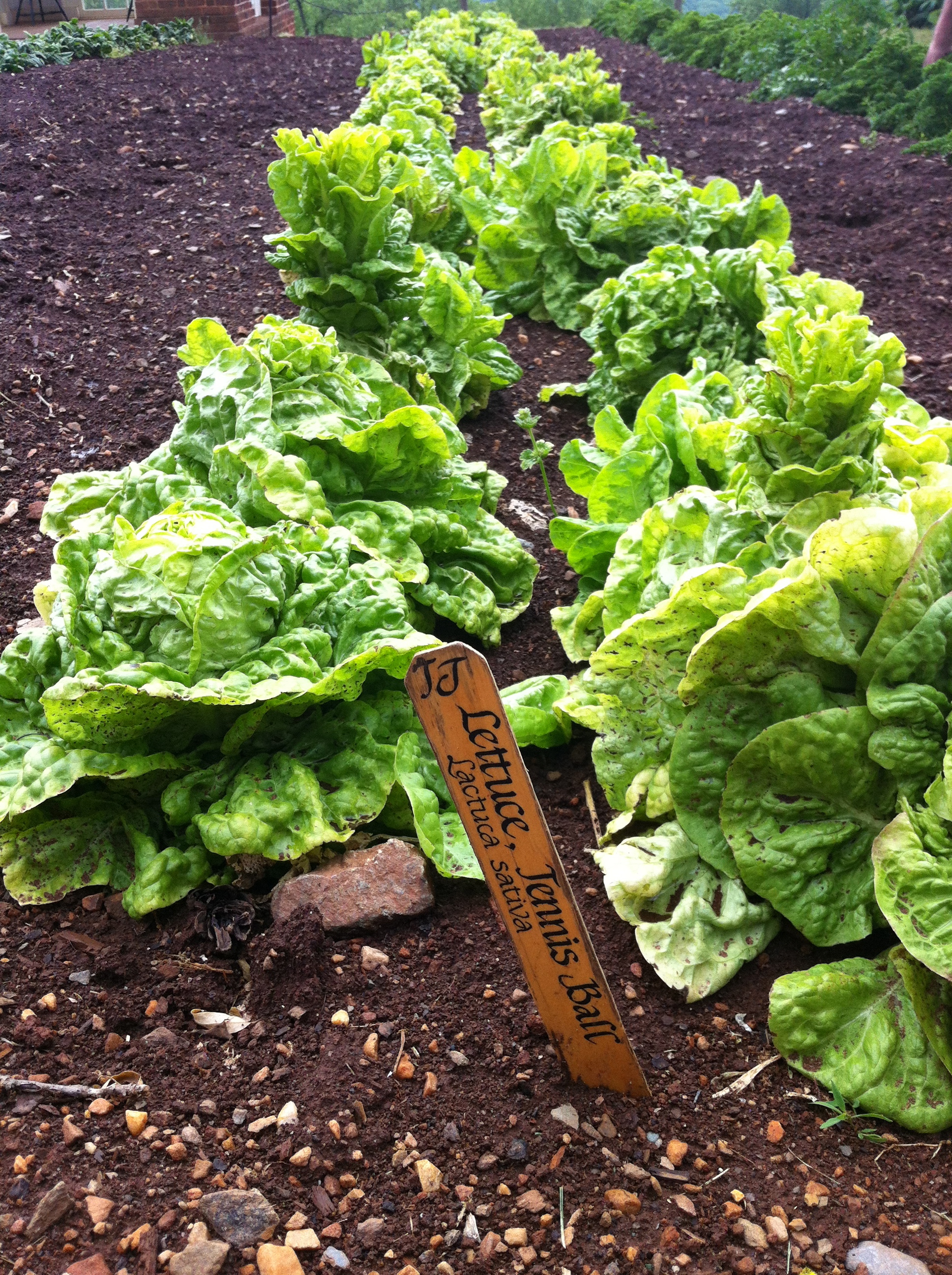
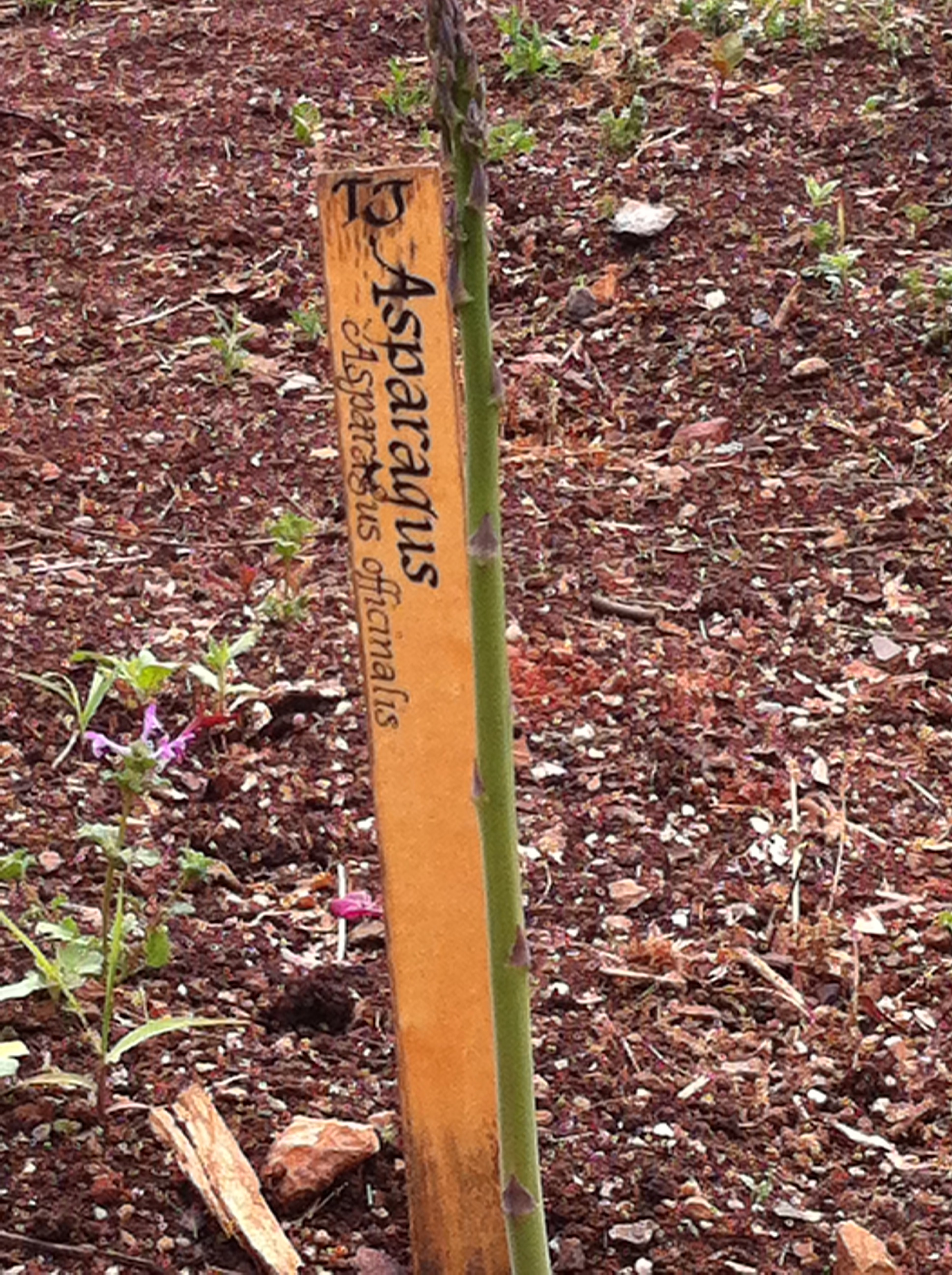
The garden is on a southeastern slope below the house. Rows of tennis ball lettuce grow on a terrace overlooking rolling hills. Asparagus stands tall at the western end of the garden. Lines of spinach, hanging onions, and turnip beets ripen in the sun as a harlequin bug drinks dew from a cabbage plant.

Tennis ball lettuce

“It was an Ellis Island of vegetables,” said Uncle Peter on a quiet and sunny day. In 1800s Virginia, people were planting what they knew from Europe—cool season crops. Jefferson introduced species from warmer climates from all over the world. His experimental garden produced tomatoes, sesame, cayenne pepper, and chickpeas to name a few crops. According to Peter’s new book, “A Rich Spot of Earth”—Thomas Jefferson’s Revolutionary Garden at Monticello, Jefferson didn’t introduce any “specific vegetable into American gardens,” but his garden showed his southern neighbors and countless visitors what was possible.

Peter Hatch

Over Jefferson’s fifty-six years at Monticello, the garden grew 330 varieties of 99 species of vegetables and herbs. Today’s garden is interpretative and planted more intensively with about 40 to 50 varieties of vegetables at a time in a pattern that a rototiller can maneuver around.

Another view of the garden

Jefferson’s idea for the garden came out of his rejection of an old world kitchen garden, which used hot beds and required intensive care. “The genius of Jefferson’s garden,” said my uncle, “was the way he laid out this microclimate to capture the warmth of the sun.” The exposure to the southeast and the heat trap caused by the terracing allowed for an unfussy garden that still produced “asparagus in December and melons in April,” Peter said. In other words, it was one big hot bed.

Asparagus

My favorite vegetable is the sea kale, at about the midpoint of the garden. It is a cabbage-like plant and native to the English seashore. At home in England, as its leaves start to unfurl in the spring, the winds cover it in sand. This coating enhances the flavor (“similar to asparagus,” says Peter) by blocking the chlorophyll and blanching the leaves leaving them virtually colorless and ethereal-looking. To recreate this blanching at Monticello, far from the sea, the plants are covered with clay pots in the winter months allowing the flavors to mellow and the color to be bleached out. The pots are removed when the plant reaches a mature height.

The sea kale and its pots

Jefferson was an eager herbivore. He was not a vegetarian. But, more then 190 years before Michael Pollan in Food Rules suggested meat be a side dish not the main course, Jefferson wrote “I have lived temperately, eating little animal food, and that…as a condiment for the vegetables which constitute my principal diet,” according to Peter’s book.

Leek fresh from the garden

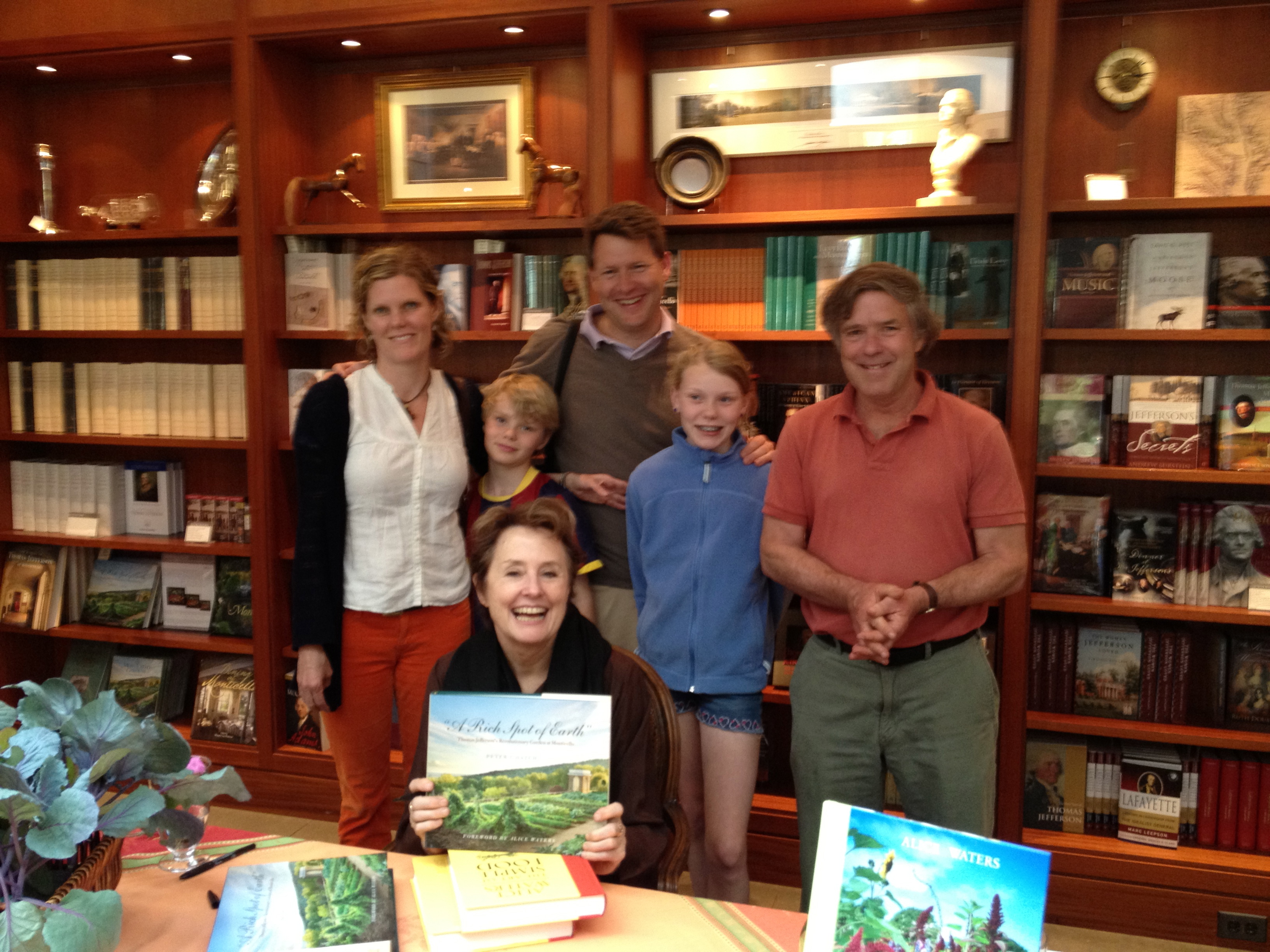
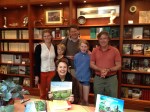
Jefferson started the garden in 1774 when he was 31 years old. But it was his retirement years from ages 67 to 83, when he spent the most time there. His favorite vegetable, says Peter, was the garden pea. The garden has an abundant patch, close to the sea kale.  It’s debatable whether Jefferson liked the peas for their taste or for the annual pea contest that, according to my uncle, “he always lost.” No matter what he tried, his neighbors’ peas harvested earlier then his.  Maybe if he had entered the tendrils, the delicate, curly sprig at the top of the plant, he would have had better luck. Alice Waters, Slow Food Nation’s founder and chef of Chez Panisse, had just picked a bunch of tendrils earlier in the day for a Monticello benefit she was cooking for the next night. “Jefferson has always been a hero of mine,” she told me later at a book-signing.
Two icons–Peter Hatch and Alice Waters

And it’s no wonder. Like Waters, Jefferson was a locavore and an organic gardener. Of course, he didn’t have any alternatives in the early 1800s. Way before “sustainable” and “composting” were buzzwords, Jefferson believed if your plants are in healthy soil they would “bid defiance” and fend off bugs and disease. He believed in the balance between wildness and cultivation, according to Peter. It should not be war in the garden against the bugs.

It’s hard to see but there is a harlequin bug in there.

In fact, he and the other founding fathers—Washington, Adams, and Madison—were big advocates of composting. According to Andrea Wulf’s book, Founding Gardeners, the four of them were concerned with declining garden yields and attributed it to lack of manuring. Any organic gardening book today suggests that layering of this organic matter not only fertilizes the soil but also foils the bugs.

So much is known about Jefferson’s vegetable garden because Jefferson was an obsessive record keeper. In his Garden Book, housed at the Massachusetts Historical Society, he included his own observations as well as information he gathered from neighbors. This “orderly, methodical, meticulous record in precise and careful handwriting I associate with a scientific mind. For a person who doesn’t give away too much about his inner self, we benefit from all this information he gathered,” said Peter Drummey, the Stephen T. Riley Librarian at the Massachusetts Historical Society.
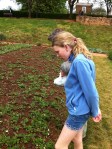
Anna B dreaming of strawberries

This discipline and thoroughness in the garden carried over to the seeds. Jefferson was a seed saver. Once collected, dried, and preserved, he would give the seeds to his friends or store for later use. Monticello continues this tradition today at its Center for Historic Plants housed on an adjacent property that Jefferson owned, Tufton Farm. Here gardeners preserve and package seeds of plants that Jefferson grew or other varieties that were common in the 19th century. No sea kale, however, because “the seeds don’t germinate well,” said my uncle.

Where the seeds are packaged

One seed that is for sale is the Whippoorwill Cowpea, also known as a crowder pea. These were not visible in the garden yet because they love the heat and humidity of the summertime. They’re like a black-eyed pea, filled with protein, and Peter boils them for hours to make gravy. They are great for the garden because they cover the ground and are nitrogen fixers, meaning they release nitrogen when they decompose leaving healthier soil. “If I had one vegetable to take to a dessert island, it would be the crowder pea,” said Peter.

Tim and Sammy with the harvest

Across a dirt path from the sea kale, there is an abundance of radiant scotch kale. We harvest enough for salad for nine. Later that evening, we eat it raw with Brussels sprouts and almonds cured in lemon vinaigrette. The taste is truly revolutionary. Who knew kale could be so yummy.

Posted in Food, Gardening, Personal Essays | Leave a comment

Pop a pill!?

 Anxiety

I read an article recently in New York Magazine called Listening to Xanax by Lisa Miller. In it she says we are no longer a Prozac Nation—to borrow the title of Elizabeth Wurtzel’s book—we are now a Xanax Nation. According to Miller’s article, over 46 million prescriptions for this anti-anxiety drug were administered in 2010. That’s a 23 percent increase since 2006. And prescriptions for all the benzodiazepines, or benzos for short, including Xanax, Ativan, Klonopin and Valium have risen 17% since 2006 to nearly 94 million each year. These are highly addictive drugs. What does this increase say about our culture and our anxiety levels?

To find out more, take a listen to Mother’s Little Helper. I produced this show for “Word of Mouth” on New Hampshire Public Radio.

Leave a comment

The Power of Prose

I am a sucker for good writing. That might sound obvious, but it’s not always easy to find. When I do, I feel transformed. Or maybe I should say transfused, like I have just received a fresh flow of blood to my brain.

According to an article in The New York Times on Sunday, Your Brain on Fiction by Annie Murphy Paul, there’s some truth to that. “Brain scans are revealing what happens in our heads when we read a detailed description, an evocative metaphor or an emotional exchange between characters. Stories, this research is showing, stimulate the brain and even change how we act in life,” Paul wrote.

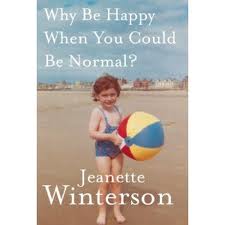
This explains my excitement over the weekend while reading Why Be Happy When You Could be Normal? Jeanette Winterson’s stunning new memoir. The second chapter of the book starts, “I was born in Manchester in 1959. It was a good place to be born.”  Those two simple sentences lead into one of the most provocative where-we-come-from-shapes-who-we-are descriptions I have ever read. I didn’t think I cared about Manchester. I’m not sure I even know where it is. (Click here to find Manchester.) I do now.

Winterson’s childhood as grim and dysfunctional as any of the other best-selling memoirs —The Glass Castle, Don’t Let’s Go to the Dogs Tonight, or The Liar’s Club—is breathtaking not only because of the author’s hopeful and resilient spirit but because of the way she tells her tale. Each sentence is clear, simple, and yet replete.

Or, to borrow a phrase from my friend Constance Hale’s must-read series on writing for The New York Times, each sentence is a “mini-narrative”. Which means by the end of this detailed, evocative, and emotional book, I should have one stimulated brain.

How exciting.

Posted in Books, On Writing, Personal Essays | 4 Comments

How to Ride a Bicycle in Boston: Three hard-learned tips for keeping it safe on the streets

Introducing my bike

There are many reasons why you should take advantage of New Balance Hubway—Boston’s bike share program–which reopened for the season yesterday. There’s the obvious—it’s good for you and for the environment. But the hidden bonus of biking around town is not only parking spaces, when and where you want them, but also your wallet. No parking tickets, no gas, no insurance, no financing, no inspections. Plus, it’s fun. Bikers smile; poor folks in gridlock don’t.

New Balance Hubway is part of Mayor Menino’s efforts to make the city more bike-friendly. It is modeled after Paris’s popular Vélib. Similar programs exist in Denver, Washington, D.C., Minneapolis and on many college campuses. Boston’s–with 600 bikes and 60 stations now but hoping to link with systems in Brookline, Cambridge, and Somerville–is the first real regional bike-sharing system in the country, according to Nicole Freedman, Boston’s bike-planning czar and a former Olympic medalist.

But, before you hop on the saddle, here are some tips to keep you looking and feeling your best.

Biking Tip 1: Assume invisibility

“Assume you are invisible to anyone in a car or truck–completely invisible, and so act accordingly,” says longtime bike commuter Sean McDonnell. Not to make you paranoid or anything but until 2007, the year Boston got its Bike Czar, our fine city was rated one of the worst in the country for biking. Now, a recent poll in Bicycling magazine shows that Boston has crawled up to spot #26 of America’s 50 Best Bike Cities. Ranking aside, obstacles still abound. Crazy drivers. Clueless door openers. Bike-munching potholes. Black ice. Flighty Canadian geese. And not enough bike lanes.

But, if you keep your eyes open and your peripheral vision fine-tuned, you’ll be okay. Make eye contact with drivers before you cross the street in front of them. When you’re zooming by parked cars, glance to see if there is someone in the driver’s seat that might door you. Ride around black ice and keep a wide berth around those unpredictable birds from the north. Go slowly and be cautious. And, potholes? Just think of them as the guy on the T with halitosis and keep away. (When you get to your destination, call the Mayor’s hotline: 617 635-4500, and report the road chasm or the downed branch. “It should be fixed within 48 hours,” says the Mayor’s office.)

And while you’re at it, keep your ears open, too. That means no iPods, headphones, or cell phones. “It’s too dangerous,” says Cambridge bike commuter Herb Wagner. Save your pod cast or Kiss 108 listening for the car.

Biking Tip 2: It’s the clothes, not the weather

In bad weather, forget about looking good. On the outside, that is. You don’t want to arrive at the office or a hot date looking like a drenched dog or smelling like a wet sheep. So, cover up and break out the foul weather gear. Buy some rain paints and a real waterproof jacket and make sure it has a hood to keep your hair under your helmet dry.  In the winter, wear what you might wear skiing. That’s right–balaclava, goggles, ski pants, gloves and warm coat. It ain’t pretty, but when you arrive at your destination just hightail it into the bathroom, shed your outer layer, and slip into your true sartorial self. Oh, and don’t forget the bike fender. It will save your clothes from a nasty dirt line down your backside.

In good weather, anything goes. You don’t need biking clothes or shoes to ride a bike. Ladies, just beware of the wind in your skirts.

Biking Tip 3: Be nice

Although it’s easy to feel self-righteous on a bike and think the rules of the road shouldn’t apply to you because you are not contributing to the world’s greenhouse gases, please think again.  “Cars are bigger and drivers can be nasty,” says Lisa Cermesak, recognizable by her helmet with horns.

Humility on a bike keeps you out of the emergency room. It also adds to the positive feedback loop: Fewer accidents mean more bikers; more bikers demand more designated lanes, resulting in fewer cars and traffic jams. That equals more smiling Bostonians.

So, as landscape architect Mary Webb says, “Just be nice.” She’s the one pedaling across the Longfellow Bridge, proudly sipping her coffee from her recently added cup holder.

Bike on.

(I have been biking in the Boston area for 7 years. I ride in all weather—snow squalls and sunshine—and love riding at night lit up like my neighborhood restaurant. I’m slow, so when you pass me, wave “hello”.)

Posted in Biking, Local, Service | 9 Comments